

Posted by Beth Noy
on October 21, 2026

As always, none of my posts are paid for but Not Swiss Cheese sent me their pillows and topper to try and here is my run down of what I genuinely thought about their range!
You know that feeling when you realise something you've used every single day for your whole life is made from plastic, and you never thought there would be a better option?
That's how I feel about my bed.
When we talk about reducing plastic at home, we tend to think about the obvious things first like cling film, plastic toothbrushes, shower gel bottles, washing-up sponges. You start making little swaps, find the products that work for you and slowly build a more sustainable routine.
But what about the place you spend around a third of your life?
I've spent years thinking about plastic in everyday products, but my mattress and bedding was something I was aware of, but did not think there was an eco option out there, Then Not Swiss Cheese got in touch!
So I thought it was worth taking a closer look. Because if we're trying to make better choices at home, surely the place we sleep deserves a little attention too!
THE PLASTIC HIDING IN YOUR MATTRESS
Let's start with the biggest part of the bed.
Most modern mattresses contain some kind of foam, and memory foam is made from polyurethane, a material derived from petrochemicals. You'll also find foam comfort layers in plenty of hybrid mattresses, even when the product is marketed around its springs or natural materials.
And here's something you might not think about: even pocket-sprung mattresses can contain plastic. The individual springs are often wrapped in small pockets of synthetic fabric, commonly polypropylene.
You might never see any of this once your mattress is made up, but it's worth knowing what's actually inside the thing you're sleeping on every night.
WHAT ABOUT YOUR MATTRESS TOPPER?
This is where things can get a little confusing.
You'll see all sorts of lovely-sounding words on bedding packaging. Bamboo, cooling, cloud-soft, natural. But those words don't necessarily tell you what a product is made from.
Plenty of mattress toppers marketed with natural-sounding descriptions actually contain memory foam, sometimes with cooling gels added. And even if the cover is made from a natural material, that doesn't mean the filling is too.
If you're looking at a topper, check the materials in both the cover and the core. They're often completely different.
If you're interested in understanding the difference between the two, Not Swiss Cheese has a useful guide to latex vs memory foam mattress toppers.
THE PILLOW YOU SLEEP ON EVERY NIGHT

This one really got me thinking.
Your pillow is something your face spends hours pressed against every single night, yet most of us probably haven't checked what it's filled with.
Many conventional pillows contain polyester fibre, microfibre (which is usually polyester made into finer fibres) or shredded foam.
They're soft, they're affordable and they're everywhere. But they're also made from synthetic materials.
If you're trying to reduce plastic in your home, your pillow is another place worth looking at when it's time for a replacement.
And don't forget to check the cover as well as the filling. A natural outer fabric doesn't automatically mean the whole pillow is plastic-free.
IS BAMBOO BEDDING ACTUALLY NATURAL?
This was one of the more interesting things I came across when looking into bedding materials.
Bamboo sounds like a brilliant choice. It's a plant, it grows quickly and it has a lovely natural reputation. But bamboo bedding isn't always quite as straightforward as the packaging makes it sound.
Most bamboo bedding is made from viscose, which is produced by dissolving plant cellulose and processing it into fibres. So, although the original material comes from a plant, it goes through a chemical manufacturing process before becoming the fabric you sleep on.
Viscose isn't plastic, and I think it's important to make that distinction. But it's also not the same thing as sleeping directly on a natural bamboo fibre.
In the UK, fibre-content labels should identify viscose as viscose, so look for the sewn-in label rather than relying on the wording on the front of the packaging.
It's a good reminder that just because something sounds natural doesn't mean we shouldn't ask a few more questions!
NATURAL LATEX: WHAT DOES IT ACTUALLY MEAN?

Natural latex is one material worth looking out for when comparing alternatives to conventional foam.
It's made from the milky sap of rubber trees, rather than being manufactured entirely from petrochemicals. But there's still a little more to the story.
Some latex products combine natural latex with synthetic latex, which is made from petrochemical ingredients. So seeing the words natural latex doesn't necessarily tell you how much natural latex is actually in the product.
If you're considering a latex mattress topper or pillow, I'd recommend asking the brand about the composition and the percentage of natural latex used.
You can also read more about natural latex vs synthetic latex if you'd like to understand the difference.
For me, this is exactly why transparent product information matters. We shouldn't have to guess what's inside something we're buying!
AND THEN THERE ARE ALL THE LITTLE BITS
It's not just the mattress, topper and pillow that deserve a closer look.
There are all the other bits of bedding that are easy to overlook:
-
Polyester in mattress covers and ticking.
-
Synthetic wadding inside quilted layers.
-
Waterproof mattress protectors that use plastic-based membranes.
-
Synthetic fabrics on the underside of toppers to help stop them slipping.
Individually, these might not seem like a huge deal. But when you start adding up everything in your bed, you realise just how many different materials can be involved.
And that's before you even get to your duvet, sheets and pillowcases!
I'm not saying we should all rush out and replace everything we own. Quite the opposite. I always think it's better to use what you already have and make a more considered choice when something needs replacing.
But knowing what to look for is a great place to start.
THE BRAND THAT WAS HONEST ABOUT ITS OWN PLASTIC
This is where Not Swiss Cheese caught my attention.
Founded by Gurveer, a former chartered accountant from Leeds, Not Swiss Cheese was created around the gaps in bedding marketing. Even its name is a little nod to all the holes in the information we're given about what goes into our beds!
The Not Swiss Cheese Organic Mattress Topper launched on 15 October and is made using GOLS-certified organic latex from Vietnam, with a GOTS-certified organic cotton casing from India, and finished in the UK.
Gurveer let me know that the products are currently having to be vacuum packed and wrapped in some plastic inside the boxes as he calculated the co2 impact of either shipping larger items (a mattress topper would take up so much room to ship if not done in this way) or reducing the size and using a plastic wrap. The latter won and whilst obviously being an advocate for stopping plastic waste, sometimes we need to think about the bigger picture. Of course this is less than ideal but as with everything he's accomplished with Not Swiss Cheese he is on the case to get this swapped to a plastic free way of doing this.
But here's the bit I really appreciated: the topper also had a 100% polyester anti-slip base.
Rather than hiding that detail, Gurveer was open about it. He explained:
"I tested every natural anti-slip base I could find and none of them gripped. A topper that slides around the bed isn't one anyone keeps, so we used a polyester base and said so."
He went on to explain that some customers wanted a completely plastic-free option, so the brand developed a Pure version without the polyester base.
He was also clear about certification. Although the latex and cotton are certified, the people cutting and finishing the topper aren't certified yet, so the finished product isn't described as certified.
I really appreciate that kind of honesty.
Let's be realistic: finding the perfect alternative isn't always easy. Sometimes a material has been chosen for a practical reason, and sometimes a brand hasn't found a solution that works for everyone yet.
What matters to me is that we're given the information to make our own decisions.
I'd much rather a brand tell me exactly what's in a product, including the bits that aren't ideal, than make something sound completely plastic-free when it isn't.
That's the kind of transparency I want to see more of!
SO, HOW DID THE PILLOWS FEEL?
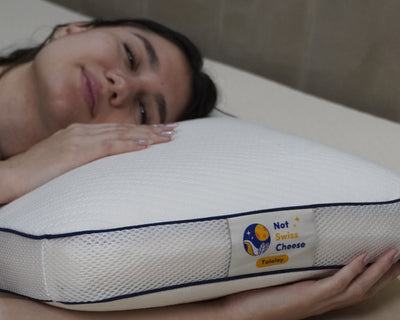
Of course, materials are only part of the story. A pillow can have the most wonderful ingredients in the world, but if it's uncomfortable, you're probably not going to want to use it.
That's why I wanted to try Not Swiss Cheese pillows and topper rather than just look at the product descriptions and honestly I am an absolute pillow snob so I was a little worried I would not like this pillow.
However I was blown away - I have a super king size bed and first of all having a pillow that fills my side of the bed without having to shift it around all night was a big sell to me. Secondly, actually having support under my neck has cured my back pain I've genuinely had every night from sleep! These pillows give the firmness of my old memory foam pillow but it's springy and soft, keeping it's shape and support all night!
HOW TO SPOT PLASTIC IN YOUR BEDDING
If you're thinking about making a few changes when your current bedding needs replacing, here are five things I'd look out for.
1. Check the sewn-in label.
Don't just rely on the packaging or the product name. Look for the actual fibre content. Polyester, polyamide (nylon), polypropylene, acrylic and polyurethane are all synthetic plastic-based materials.
2. Find out what's inside.
A cotton cover doesn't necessarily mean a natural filling. Always check the materials used in the outer cover and the inner core separately.
3. Don't assume bamboo means bamboo fibre.
Look for the fibre-content label and check whether the fabric is listed as viscose. It's a plant-derived fibre, but it has been chemically processed.
4. Ask questions about natural latex.
If a product is advertised as natural latex, check whether it's 100% natural latex or a blend containing synthetic latex. A transparent brand should be able to explain what you're buying.
5. Check what the certification actually covers.
Certifications can be really useful, but it's important to understand exactly what has been certified. Does it cover the latex, the cotton casing or the finished product? And which parts of the manufacturing process are included?
The more specific the information, the easier it is to make an informed choice.
NOT SWISS CHEESE NOW AVAILABLE AT PLASTIC FREEDOM
If you'd like to explore the range for yourself, I now have Not Swiss Cheese available at Plastic Freedom!
And if there's one thing I'd love you to take away from this post, it's this: you don't need to replace everything in your house to make a difference.
Sometimes, making a better choice simply starts with asking what's actually inside the things we use every day.
We've got pretty good at looking for plastic in our bathrooms and kitchens. Maybe it's time we started looking in the bedroom too!
After all, the most sustainable swaps are the ones we make thoughtfully, when we're ready, and with all the information we need to choose well.


